

Airspace Infringements
The UK Civil Aviation Authority (CAA) recently published CAP 3277: Airspace Infringements: Causal Factors 2025, which you can read in full here https://airspacesafety.com/wp-content/uploads/2026/06/CAP3277.pdf
While the headline data shows a encouraging 2% reduction in overall airspace infringements compared to 2024—and a substantial 20% drop since General Aviation returned to normal post-COVID in 2022—the report contains vital lessons specifically for the microlight community.
As microlight aircraft grow more sophisticated and frequently share complex airspace corridors, understanding our baseline data, the operational impact of infringements, and how to avoid them is essential for maintaining our freedom to fly.
The Data:
Out of the 1,136 total reported airspace infringements across the UK in 2025, powered aircraft naturally made up the vast majority (94%) of occurrences.
- Microlights were responsible for 104 reported airspace infringements.
- Helicopters were 116 and Gliders 26
- The Repeat Offenders: Alarmingly, in 9% of total cases, the pilot-in-command had infringed airspace at least once in the previous two years.
- Instructors: 13% of overall infringements were by Instructors
What Happens When We Infringe?
An airspace infringement is defined as the unauthorized entry of an aircraft into notified airspace (including CTRs, CTAs, TMAs, ATZs, RMZs, and TMZs). When a microlight inadvertently slips into these zones, the safety repercussions are immediate:
- Loss of Separation: In 2025, hundreds of cases required immediate intervention because the infringement either caused a direct loss of standard separation with commercial traffic or forced air traffic controllers to implement emergency safety measures.
- Disruption to Air Traffic Management: To keep the skies safe, controllers are often forced to issue avoiding action instructions, radar vectors, halt climbs or descents, or even suspend airport departures entirely.
- Licensing Actions: Under the CAA’s "Just Culture" framework, the primary focus is education, resulting in hundreds of mandatory education letters, online tutorials, or Airspace Infringement Awareness Courses (AIAC). However, serious or repeated lapses can lead to formal practical flight training requirements or the provisional suspension of a pilot's license.
Causal Factors and Hidden Threats
The CAA's analysis points to several prominent human factors and technical traps that frequently catch microlight pilots off guard.
1. Over-Reliance on VFR Moving Maps
Moving map technology is an incredible tool supported by the CAA, but it has introduced new risks. Many pilots are using moving maps as their sole source of flight planning and navigation, leading to dead-reckoning skill fade. Furthermore, "alert fatigue" causes pilots to quickly dismiss screen warnings without mentally processing the threat, while vertical infringements often happen because a pilot dismisses an initial airspace warning during a slow, continuous climb.
2. The Trap of Low Atmospheric Pressure
Altimetry remains a critical vulnerability. On days with exceptionally low barometric pressure pilots operating on local QNH have inadvertently flown into controlled airspace whose floor is defined by a Flight Level. Because GPS altitude displayed on moving maps does not accurately match barometric altitude, pilots can suffer a total loss of vertical situational awareness.
3. Local Flying Area (LFA) Lapses
A significant number of infringements occur right after take-off or during arrival at airfields adjacent to controlled airspace. Pilots frequently fail to monitor their performance, climb rates, or altimeter settings, inadvertently slipping laterally or vertically out of the safe confines of an LFA.
How to Avoid Infringing
To protect your license and keep UK airspace safe, incorporate these practical habits into every flight:
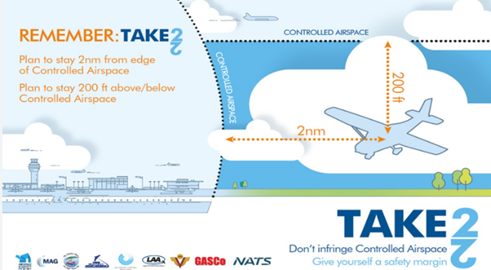
- Apply the "Take 2" Guidance: Whenever practical, plan your route to remain 2 NM laterally and 200 feet vertically away from the boundaries of notified airspace. This airmanship buffer gives you a margin for error against wind drift or unexpected thermal lift.
- Cross-Check with Regulated Material: Do not rely exclusively on third-party moving map apps. Always cross-examine your route using official NATS AIS products https://nats-uk.ead-it.com/cms-nats/opencms/en/home/ for updated NOTAMs, temporary restricted areas, and official VFR charts.
- Optimize Your Audio & Alerts: Ensure your moving map application is fully configured to route audible warnings directly into your headset if Bluetooth enabled. Check your moving map settings, so you know what and when airspace alerts will appear on screen.
- Master Your Altimetry: If you are flying under or near controlled airspace structures, do not default to the Regional Pressure Setting (RPS) if it puts you at risk. You are fully entitled to request and set the relevant aerodrome or zone QNH, ensuring your altimeter reads perfectly relative to the airspace ceiling.
- Use Listening Squawks (FMCs): Take advantage of Frequency Monitoring Codes. Utilizing one of the 26 available UK codes allows controllers to practice "defensive controlling"—meaning if they see your track heading toward an infringement, they can actively intervene on frequency to warn you before a breach occurs.
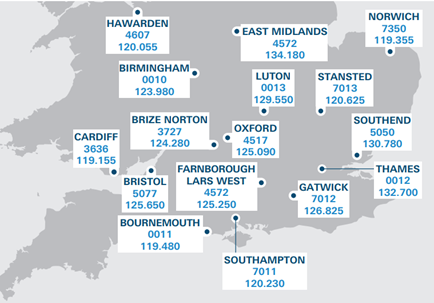
Visit the Airspace & Safety Initiative here https://airspacesafety.com/ where you can see more information on hotspots, advice and what to do if you think you have infringed. Head over to their resources area to listen to some excellent podcasts on RT and the work of the team or download their briefing cards.
if you’d like to polish you flying skills to help avoid an Infringement you could join one of our new BMAA One day courses on In flight decision Making or Skydemon, with more information here https://www.zeffy.com/en-GB/organizations/british-microlight-aircraft-association

As always, any comments or questions contact me at safety@bmaa.org


